Look: I am eager to learn stuff I don't know--which requires actively courting and posting smart disagreement.

But as you will understand, I don't like to post things that mischaracterize and are aimed to mislead.

-- Brad Delong

Copyright Notice

Everything that appears on this blog is the copyrighted property of somebody. Often, but not always, that somebody is me. For things that are not mine, I either have obtained permission, or claim fair use. Feel free to quote me, but attribute, please. My photos and poetry are dear to my heart, and may not be used without permission. Ditto, my other intellectual property, such as charts and graphs. I'm probably willing to share. Let's talk. Violators will be damned for all eternity to the circle of hell populated by Rosanne Barr, Mrs Miller [look her up], and trombonists who are unable play in tune. You cannot possibly imagine the agony. If you have a question, email me: jazzbumpa@gmail.com. I'll answer when I feel like it. Cheers!

Tuesday, February 5, 2013

I Am Become Infamous

My blogging reached a high-water mark this week.

A while ago I wrote a snarky rant here about some stupid Krugman bashing from Mish and others.

I reworked that post to make it suitable for a wider audience at Angry Bear.  It can be found here.

Krugman picked it up from AB and linked to it from his blog.

I'm a big Krugman fan, in case you haven't noticed.

Getting a call-out from him is tres cool.


Saturday, February 2, 2013

Mish Mashes the McRib

The McRib returneth.  Be very afraid.

As much as I castigate Mish for his libertarian cum Austrian fantasies, he's not all wrong, all the time.

Here, he enlightens us on the McRib, which is in fact not made of ribs.

Quoting The Natural Society, Mish shares this information.  [Quotes excerpted and not in the order presented]

But what’s really inside the McRib specifically that makes it such a food abomination? Containing over 70 ingredients, the McRib is full of surprises — including ‘restructured meat’ technology that includes traditionally-discarded animal parts brought together to create a rib-like substance.
.   .   .  
Out of the 70 ingredients that make up the ‘pork’ sandwich, a little-known flour-bleaching agent known as azodicarbonamide lies among them.
.   .   .
 In Australia and Europe, the use of azodicarbonamide as a food additive is banned. In Singapore specifically, use of this substance in food can result in a $450,000 fine and 15 years in jail.
.   .   .
Since McDonald’s knows you’d never eat a pig heart, tongue, or stomach on your plate, they decided instead to grind up these ingredients and put them into the form of a typical rib.
.   .   .  
So in other words, it’s not actually a rib. Instead, it’s a combination of unwanted animal scraps processed down in major facilities and ‘restructured’ into the form of a rib. Then, 70 additives, chemicals, fillers, and GMO ingredients later, you have a ‘meat’ product that tastes like ribs.

Azodicarbonamide. Yum!

Of course, this problem occurs because of unfettered capitalism, placing bottom line profits above any other considerations, including health and decency; and the obvious solution is more stringent regulation - maybe something along the lines of what they have in that capitalist paradise, Singapore.

I wonder what Mish would think about that.

Quote of the Day

"There are some people in politics and in the press who can't be confused by the facts. They just will not live in an evidence-based world. And that's regrettable. It's regrettable for our political system and for the people who serve our government in very dangerous, difficult circumstances."

--  Hillary Rodham Clinton

Thursday, January 31, 2013

Sunday, January 27, 2013

Deep Stupid #23: How to Debte Paul Krugman

On Saturday Mish wrote an almost unbelievably stupid article with those words in it's title.

The article borrows these words and includes a quote from an even more unbelievably stupid article by Austrian school economist and author Detlev Schlichter.  Part of that quote is presented here.

What makes him [PK] so annoying is his unquestioning, reflexive and almost childlike enthusiasm for state intervention, even in the face of its obvious failure, and his apparent unwillingness to probe any deeper into the real causes of our present economic problems or to show any willingness to investigate the effectiveness or ineffectiveness of his particular medicine.


Wow!  Does that sound anything like the Paul Krugman who puts his ideas out there for the world to see on a daily basis?  When the opportunities smack me in the face like this, I put on my Krugman Truth Squad hat.  You have to wonder if Herr Schlichter has ever bothered to read anything that Krugman has written.  His article - which I cannot recommend highly enough - is an impressive exercise in half-truths, distortions, make believe, and straw man stuffing, seasoned with more than a soupcon of bovine excrement.  [As an ironic aside, when I was an impressionable youth, it was the fuzzy-headed liberals - aka commie-sympathizing leftist pinko radicals, who were alleged to operate in that manner -- but that was the 60's and I digress.]

Though this statement [emphasis added], "Krugman is the one who should be made to explain his policy recommendations and who has to answer the criticism that policies like the ones he is recommending got us into this mess in the first place and that his policy ideas have been implemented for years to no effect, at least no positive effect." is hard to beat for sheer negation of reality, the real capper is this: "Krugman is practicing Keynesianism as a religion."

It is because of statements like this that I lose patience with people who use words like "disingenuous."  Schlichter is either bloviating from a state of abysmal ignorance, spouting nonsense that exists only in some delusion-based distortion of reality, or simply lying.  The proof is in Krugman's Op-Eds and blog posts, where he repeatedly demonstrates reality with graphs and tables, shows how austerity is failing right now with real-world examples, and admits it when he gets something wrong.  When is the last time you saw a Krugman-hater do that?

I guess I should also mention that, in my most humble opinion, the ever-so-devout Herr Schlichter is projecting.

Mish, to his eternal discredit, says of this nonsense: " Moreover, it appears to be 100% accurate."

But, Mish continues, the real way to debate Krugman is demonstrated by Economist Hans Hermann-Hoppe in this one minute video.


This is genuinely awesome.   That an economist can be so thoroughly wrong - wrong in general and wrong in every particular - about what Keynesianism is and does, leaves me speechless, and that's saying something.

OK - almost speechless.  Forget the trivially unimportant technical details and ask simple-minded, allegedly probing questions that are totally unrelated not only to the policies Keynes and Krugman propose, but to anything else in the real world, and then point and stare when these questions cannot be answered - by anyone, while your minions nod approvingly.

But would it work?  Mish concludes this way:

Krugman would respond with incomprehensible gibberish "for wonks only" as well as typical Keynesian nonsense about how paying people to dig holes and other people to fill them up would start a chain reaction of growth.
A child would see the answer was preposterous, but not a trained economist, politician, or brainwashed academic. Paul Krugman, keynesian economists in general, politicians wanting a free lunch, and most academics are all incurable.
Nonetheless, Hans Hermann-Hoppe's answer is indeed the correct one. By asking questions a child will understand, some non-brainwashed people will see Keynesian and Monetary stimulus for what they really are: economic stupidity.

Setting aside for the nonce Mish's apparent inability to distinguish between monetary and fiscal stimulus*, at this point it looks as if he - with his straw man army and blatant intellectual nihilism -  and I have devolved into a schoolyard game of calling each other stupid.  But I'm quite sure Mish is not stupid, and I'm fairly certain I'm not either.  The real questions are these: who is paying attention to reality, whose policies make things better or worse in a given situation [absolutism, anyone?] and whose concepts have had some predictive power over the last several years.  [Here's a hint: it's not the Austerians.]

So, maybe a better way to phrase it is, "Who is practicing their economics as a religion?"

__________________________
* Update: In a follow up article [with a 5 point list that includes 2 naked assertion and 3 irrelevancies {seriously - Zimbabwe?!?}] Mish indicates that monetary and fiscal stimulus are BOTH stupid.  The confusion was mine.


Friday, January 25, 2013

Another look at Spending and Revenues

How many times have you heard Boehner, McConnell, Ryan or one of the legion of right-wing talking heads say, "We don't have a revenue problem, we have a spending problem?"  I refuted that lie repeatedly in this AB post and at the included links.   But this is one of those zombie ideas that simply will not stay in the grave.  

Therefore, some prominent voices have found it necessary to sing out again against the lie. I will add my humble quavery baritone to the chorus.

Here in Graph 1 is Kevin Drum demonstrating how Real Government Expenditures per Capita have changed under the last three presidents.

What we have isn't a spending problem. That's under control. What we have is a problem with Republicans not wanting to pay the bills they themselves were largely responsible for running up.


 Graph 1, Real Government Expenditures per Capita

By using real [inflation adjusted] and per capita numbers, Drum has introduced a couple of denominators.  Real expenses per cap is a rational way to display the data, but not the only way. So lest someone cry out about that ol' devil denominator, let's have a different look.

Via Paul Krugman we get Graph 2 and Graph 3, from FRED, showing total Government expenditures and Federal Government expenditures, respectively, on log scales.


Graph 2. Government Total Expenditures


Graph 3, Federal Government Total Expenditures

Yes, you can argue that spending was growing too fast under Bush, although it’s funny how few deficit scolds saw fit to mention that at the time. Or you can say that you just want less spending, although as always people who say this tend to be short on specifics. But the narrative that says that spending has surged under Obama is just wrong – what we’ve actually seen is a slowdown at exactly the time when, for macroeconomic reasons, we should have been spending more.

Remember, a log scale represents constant growth as a straight line, and zero growth as a horizontal line.  So, in pure dollar numbers, spending hasn't quite declined, but it has stagnated to almost zero growth.  Hence Drum's decline in inflation adjusted, per capita terms.

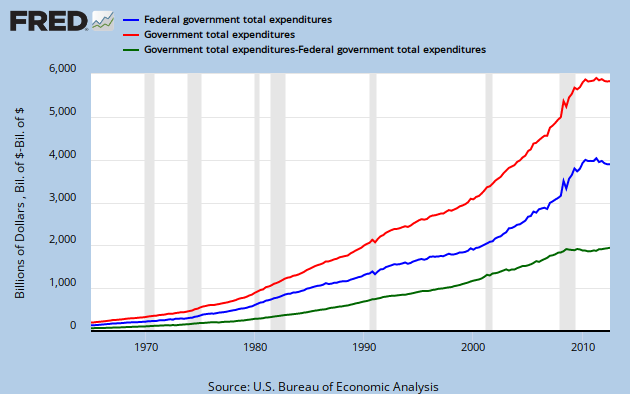
In Graph 4, we get one more longer range look, using Krugman's data series, this time on a linear scale.  Also presented is the difference between the two, which is the amount of spending by state and local governments.


 Graph 4, Government Spending at Different Levels

 The red line is total spending at all levels of governemnt, the blue line is federal only, and the green line is the difference, state and local spending.  Note that the green line flattens early in the recession

To bring things full circle, Graph 5 shows Federal Government current receipts.  Look at this and tell me we don't have a revenue problem.


Graph 5, Federal Government Current Receipts

To drive this point home, Graph 6 shows Federal Receipts as a fraction of GDP.  The purpose of the ratio is to provide context, using GDP as a proxy for the size of the economy.


Graph 6, Federal Receipts as a fraction of GDP

As you can see, revenues/GDP are in a historically low range.

Conclusions:
- Federal spending is flat in nominal dollar terms.
- Federal spending is declining when adjusted for inflation and population growth.
- Federal revenues are far below trend lines based on any historical reference you chose.
- Federal revenues as a fraction of GDP are historically low.
- The Republican claim that we have a spending problem not a revenue problem is simply a lie, on both counts.
- Disproportional spending growth has only occurred under two presidents: Republicans Ronald Reagan and George W. Bush. 

Why do Republicans lie?

The truth is hostile to their agenda.  PK Explains.

Sunday, January 6, 2013

Hagel for Secretary of Defense

I'm actually agnostic on this choice.  The always excellent Charles Pierce makes a good case for Hagel, but why should Obama go for any Republican?  This just continues to promote the canard that Republicans are somehow stronger or more capable on defense issues than Democrats.

The irony here is that the greatest opposition is coming from Republicans, some of whom have gone so far as to call him an anti-Semite*  because he has spoken openly and honestly about the excessive influence the pro-Israel lobby has on American foreign policy.   When we consider the pros and cons of any individual for any position, we ought to do it on the basis of real qualifications and real disqualifications, not make-believe nonsense put forward by neocons and the cadre of rabid right-wingers whose policies have done such great and possibly irreparable damage to the world in this century.
 
I rarely agree with Mish on anything political, and to find myself agreeing in principle with him when he's agreeing in principle with Patrick Buchanan has my stomach turning and my head spinning. 

Vertigo, nausea and angular momentum aside, this appointment is the president's decision, and I want to see the debate precede along substantive rather than ideological, illogical or untruthful  lines.   And I most particularly don't want to see him get Riced.

Now, where do I pick up my pony?

__________________________

*  Update: On 1/07 I heard Eliot Abrams do exactly that in an NPR interview.  Abrams was an Iran-Contra cohort of Paul Wolfowitz and Oliver North.

Saturday, December 29, 2012

Psuedo-Ecnomics Round Up for 2012

Menzie Chin regales us with his list of the top 10 examples of economic malfeasance for CY 2012.

Time to emulate the media’s "year in review" pieces, with my own take on the most outrageous, nonsensical assertions presented in the guise of analysis. Here are my ten most hilariously deluded excursions into the fantasy world from my postings to Econbrowser. The inspirations range from (once again) the Heritage Foundation's analyses (where have you gone, Bill Beach!) to the ongoing search for hyperinflation/crowding out.

The Hunt for Gollum

The first part of this is rather slow moving, but overall it's really well done. It's a little over a half hour of movie, followed by several minutes of credits.  Every once in a while, the guy playing Aragorn almost looks like Viggo. The music is original but is totally compatible with with Howard Shore's LoTR sound track.  

Going to see the Hobbit movie tomorrow with several grandchildren.  Should be a great time.


Web Page

You Tube Link


Saturday, December 22, 2012

Bork's Deep and Abiding Influence

After his defeat as a Supreme Court nominee in 1987, Robert Bork gradually faded away from the public consciousness.  I can tell you, in the intervening 25 years, I probably gave him no thought at all.

But Bork had enormous influence on the modern interpretation of anti-trust law, perhaps single-handedly redefining the scope and purpose of anti-trust legislation.  Basically, Bork was pro-efficiency and anti-anti-trust.  He swallowed whole the bait-bucket of Chicago-economic-school ideas of market efficiency, and built the entire framework of his pro-trust belief system on that invalid foundation.

It seems fair to say that it is in large part because of Bork's influence that we now have trans-national mega-corporations with huge monopolies and oligopolies.  These corporations have no inherent loyalty to anyone nor anything.  In my view, the oligarchs that run them do not even have a general sense of loyalty to stock-holders, let alone the broader universe of sake-holders, who mainly exist to be exploited.

Efficiency, in and of itself is a good thing.  But it cannot be achieved in a vacuum - there are externalities that are largely negative.  For one thing, the efficiencies are mainly internalized and do not necessarily represent a more broadly efficient society.  Second, as a market gets concentrated, competition decreases and the pressure to improve, or even maintain status-quo efficiency slowly erodes.  This ultimately leads to a situation where big, lumbering, inefficient but extremely powerful entities control the economic and political landscape.  Yes, Big Oil, Big Pharma, Big insurance, Big Finance, I am looking at you.

Perhaps worse, though, is the power asymmetry that results from size and influence.  Suppliers, customers, and the public at large are overwhelmed by the sheer might of these institutions, leading to even greater concentrations of power and wealth.

The end game is some version of economic collapse.  It happened in the 1930's, and - due largely to Chicago-style economic thinking, we've spent the last 40 years unlearning the lessons of that time - it happened again in 2008.

Most of the time, evil doesn't manifest as some cackling cartoon villain or mad-man on a murderous rampage.  It results, in a far more banal but far-reaching way, from the highly refined ideas of men like Robert Bork who value abstract concepts like efficiency over the effects the programs they institute over the lives of real human beings.

The Borking of Bork

After the nomination of Robert Bork to the Supreme Court was defeated by a 58-42 vote, his name was verberized into a neologism that was [and occasionally still is] used almost exclusively in the passive voice.

To be "borked" as his supporters would have it, is to be subjected to unfair criticisms based on distortions of your words, actions, and beliefs.   In reality, the borking of Bork consisted of subjecting him to valid criticism based on the precise meanings of his words, actions and beliefs.  Jeffrey Toobin explains.

Bork was “borked” simply by being confronted with his own views—which would have undone many of the great constitutional landmarks in recent American history. As Senator Edward Kennedy put it in a famous speech on the Senate floor, “Robert Bork’s America is a land in which women would be forced into back-alley abortions, blacks would sit at segregated lunch counters, rogue police could break down citizens’ doors in midnight raids, schoolchildren could not be taught about evolution, [and] writers and artists would be censored at the whim of government.”

Was Kennedy too harsh? He was not—as Bork himself demonstrated in the series of intemperate books he wrote after losing the Supreme Court fight and quitting the bench, in 1987. The titles alone were revealing: ”The Tempting of America,” “Slouching Towards Gomorrah: Modern Liberalism and American Decline,” and “Coercing Virtue: The Worldwide Rule of Judges.” One of his last books may have summed up his views best. Thanks in part to decisions of the Supreme Court—decisions that, for the most part, Bork abhorred—the United States became a more tolerant and inclusive place, with greater freedom of expression and freedom from discrimination than any society in history. Bork called the book, accurately, “A Country I Do Not Recognize.”

Thursday, December 20, 2012

Rabid Ferrets

The bloody, tattered remains of what was once known as a "progressive agenda" continue to straggle on in a state of diminished capacity, ironically only surviving at all due to the irrational actions of a rag-tag gang of "rabid ferrets." What a weird time we live in.

I'm starting to understand Chinese curses.

UPDATE 12/21:  During the Shrub administration, I noted that the Rethugs were terrible at government, and a big part of the reason why was that they had such contempt for governance.

The rise of the vaccuous, know-nothing Tea Party movement, with their agenda of amorphous anger and unfocused hate, has made it worse by several orders of magnitude.  At least the Bush Rove cadre understood what the hell politics is, though they co-opted it to nefarious ends like pointless, unjustifiable war and an attempt to privatize Social Security.  The New Rethugs can't even comprehend what the hell politics is, but their party has gerymandered their way into a likely permanent majority in the House.

Charlie Pierce, brilliant as always, elaborates. [Though he did miss rabid ferrets]
There is no possible definition by which the Republicans can be considered an actual political party any more. They can be defined as a loose universe of inchoate hatreds, or a sprawling confederation of collected resentments, or an unwieldy conglomeration of self-negating orthodoxies, or an atonal choir of rabid complaint, or a cargo cult of quasi-religious politics and quasi-political religion, or simply the deafening abandoned YAWP of our bitter national Id. But they are not a political party because they have rendered themselves incapable of politics.

Read more: Wherein Democracy Mocks Itself - Esquire http://www.esquire.com/blogs/politics/Over_The_Cliff_Already#ixzz2FhEOsd9Y