Look: I am eager to learn stuff I don't know--which requires actively courting and posting smart disagreement.

But as you will understand, I don't like to post things that mischaracterize and are aimed to mislead.

-- Brad Delong

Copyright Notice

Everything that appears on this blog is the copyrighted property of somebody. Often, but not always, that somebody is me. For things that are not mine, I either have obtained permission, or claim fair use. Feel free to quote me, but attribute, please. My photos and poetry are dear to my heart, and may not be used without permission. Ditto, my other intellectual property, such as charts and graphs. I'm probably willing to share. Let's talk. Violators will be damned for all eternity to the circle of hell populated by Rosanne Barr, Mrs Miller [look her up], and trombonists who are unable play in tune. You cannot possibly imagine the agony. If you have a question, email me: jazzbumpa@gmail.com. I'll answer when I feel like it. Cheers!

Tuesday, January 31, 2012

Quote of the Day

It is better to be a human being dissatisfied than a pig satisfied; better to be Socrates dissatisfied than a fool satisfied. And if the fool, or the pig, are of a different opinion, it is because they only know their own side of the question.
- John Stuart Mill

Sunday, January 29, 2012

The Real World of Real Work

I was reminded again of this, while reading this comment from Steve, at his own blog (following Art's link.) 

My sister, after abandoning the Berkeley Phd astrophysics program, ended up [with no programming experience] programming those Visa mainframes that process billions of transactions a night — in assembler! I asked her once if she used any of her higher math from college, calculus and such. “No,” she said, “we pretty much just add and subtract. On rare occasions we’ll get really abstruse and multiply or divide.

Which is tangential to the topic Steve, et. al. were discussing, but keys right into something that I was thinking about.  I have two degrees in Chemistry, B. S. and M.S.  I worked in industry from early June of 1968 until the end of November in 2008 - a tad over 40 years.  If you aggregated all the time I spent doing actual chemistry, it might total a few months; certainly it was far less than two years.  If you aggregated all the time I spent doing things where my knowledge of chemistry directly informed my ability to function, it would total somewhere in the range of 15 to 20 years.  Dealing with Mechanical Engineers threw this into stark relief.  A typical Mechanical Engineer simply would have been incapable of doing my job.  Just as I would have been incapable of doing her's - for that 30 to 50% of the time, unless I received some amount of specific training.*  Also, I'll posit that specific engineering knowledge was a relevant enabler to the M.E. no more than 50% of the time.

Here is a related anecdote.  Some of my musician friends are employed as computer programmers.  Their education is in music.  Their employer specifically seeks musicians because training them is especially easy.  There is some sort of fit between the musician's mind and the tasks to be performed.

My point is that doing something other than what you were educated to do is not a misuse of talent, except in the most egregious examples - frex PhD' physicists driving cabs, Engineers delivering pizzas, Accountants digging ditches, Economists doing economics.  (Sorry, couldn't resist the dig.)

Realistically, your education does not prepare you for the world of work, and most specifically, the chance of it preparing you for the job you actually get is almost vanishingly small.

__________________________________________

* Some of this is skill and training related, and some has to do with individual brain idiosyncrasies, interest level and willingness to learn.  I'll bet I could learn the M.E.'s job with very little additional training.  Engineering is applied math, and I'm reasonably good at that.   Not so the other way around.  At the briefest mention of anything remotely chemical, the M.E.'s eyes glaze over.  Persist, and they will run, screaming, from the room.

Saturday, January 28, 2012

Right to the Moon

My Lovely Wife suggested that I make a blog reference to the Newster's moon base idea, incorporating Ralph Cramden's classic threatening, fist-in-her-face line: "One of these day's Alice . . . . Pow - right to the moon!"

Well, that's how I remember it, anyway.

I am nothing, if not obedient.  My intent was to find (rather cop-outishly, I'll admit) a brief YouTube clip featuring that line.  But, alas, no.  If you can do better, please let me know.

Then, she went and found this page.  Hoo-boy.  Pwned by my spouse.

At the link above, Groobiecat did all the heavy lifting, and put up a damned good post, including a fun Photoshopped pic.  A must-read, I'd say.

Now, by way of fair and balanced (choke!) reporting, I'll also direct you to the ever independent-thinking Tux's defense of the out-of-this-world Newtonian moon-base idea.

 My answer to Tux's "What's the matter with a Moon base?" question includes these points:
- the cost, which in a world filled with austerians, is an automatic no-go;
- the lack of a real need to do anything specifically lunar;
- the unsustainability of a moon base;
- Newt is a lying political opportunist, playing to the Florida space industry base.  His plan isn't a realistic proposal.  It is a cynical, pandering ploy for votes;
- did Newt really float the idea of the Moon becoming a 51st State, or was that commentator hyperbole?

Tux talks about employing all sorts of highly skilled professionals in this potential program, and you can't simply gainsay that.  However, on balance, the negatives overpower, I think.  Besides - isn't there some sort of a project, right here on earth, that would employ all those same skilled professionals, while doing something real?

Space exploration has a very high cool-geek factor.  But, deep in my heart, I believe the time for manned space exploration has come and gone.  Actually, several decades ago.

There are pressing needs here at home, and excess brain-power available to devote to solving them.

Shouldn't there be some realistic way way to bring them together?

On the other hand, though - and more fundamentally - we don't have structural unemployment.  If we did, this kind of specific skill-matching program would be right on the mark.  What we do have is general unemployment.  The answer to that is to correct the aggregate demand shortfall.

I wonder what Keynes would say?

Friday, January 27, 2012

What the Hell?!? Friday - Memory


Is This Where The Newt Slithers Back Under A Rock?

I didn't watch the Rethug debate last night.  there is only so much idiocy I can take without having my head explode.  But, from what I've gathered, Newt more or less imploded.  Maybe this was predictable.  The man is wildly erratic.

Krugman whimsically posts this.

You needn't click through, here is the vid he embedded, saying only: "I gather from those who watched the debate that this is pretty much over."


My take as a jazz guy has to do with the music, rather than the message.

I find it quite interesting that Diana Krall's performance is so informed by this Sammy Nestico arrangement.  I've played it many times, and it comes close to being my absolute most favorite arrangement of anything.


UPDATE: In comments, nanute directs us to this, earning a big H/T.


Wealth vs Income

Usually my articles present facts and data and try to drive down to a conclusion. This time, I'm going to drive down to a couple of questions.

Recently, Noah Smith had a post on the subject of economic models titled Filling a hole or priming the pump?  It did quite a bit to restore my lack of faith in the pseudoscience of Economics, but that is more or less beside the point.  Roger Farmer, cited in the post, left a long comment that Noah hoisted up the main page.  Farmer concludes:

My reading of the evidence is that consumption depends primarily on wealth rather than income. That was the lesson of work by Ando and Modigliani, Modigliani, and Friedman in the 1950s. It is for that reason that I support interventions in the asset markets that try to jump-start the economy and reduce unemployment by boosting private wealth. That, in my view, is what quantitative easing has done.

Ok - I'm taking on decades of economic research here, but my first question relates to: "My reading of the evidence is that consumption depends primarily on wealth rather than income."

First, let's remember that wealth distribution is on the order of the top 1% owning 40% of the wealth, and the bottom 80% owning 7% of the wealth. And that 7% is not evenly distributed.  There are significant fractions of the population who have a) no wealth at all, or b) negative net worth. Either way, they are living hand to mouth.  This suggests that 1) they have unmet needs, and 2) will spend the next available dollar trying to satisfy one of them. 

Wednesday, January 25, 2012

Poor People Have Shitty Lobbyists

I think that is what Stewart says at the end of the clip.

Meanwhile, here are some good insights into the mind of Mitt.


Despicable!

Frankly, I was appalled by the Gingrich response to John King's open marriage question last week at the start of the 75488929th Rethug "debate."  It got worse, but we'll get to that later. 

Newt did what conservatives always do when they have no answer.  He changed the subject.

He did what Rethugs always do when they should rationally be considered defenseless.  He flipped the enormous negative into an enormous positive.  Here, I'll just turn it over to John Stewart, who is an actual professional at this sort of thing.


It's later.  Here's the getting worse part.  Newt was trailing significantly in S.C. until he unleashed his inner bulldog on the utterly hapless John King.  Whether this was a planned outcome or King was simply totally unprepared is something I'll let the conspiracy theorists sort out.  But it's clear that at that moment Newt won the flinty hearts and defective minds of the the sociopathic mob known as the South Carolina Rethug electorate.

As exhibit B, I'll point out that when revelations of Herman Cain's sexual harassment surfaced, his campaign received a surge of donations.  

This is sick, appalling, and - yes - despicable.

This is what conservatism has degenerated into.

This is the modern Republican party.


Tuesday, January 24, 2012

Stockman on Crony Capitalism


Holy socialization of losses, Batman.  I had no idea I was channeling David Stockman when I wrote this post.  Thing is, Stockman is an unreformed free-market Reaganite supply-sider.  But not quite the free market guy I imagined him to be, as it turns out - a least as it regards Glass-Steagall and derivatives regulation.  He's all about a certain kind of creative destruction, though, that I find myself applauding.

Notable quote:  "If it's to big to fail, it's too big to exist."

I listened to this with an ear toward finding something I would disagree with.  The most I can come up with is his cry for "free market capitalism," past the the 30 minute mark.  Amazingly, at the end, he even channels Bernie Sanders.  I'll never be a Stockman fan, though.  


What's striking is that when someone as far to the right as he is lines up on the same side of an issue as I do, it shows just how far out of bounds things have gone. 


David Stockman on Crony Capitalism from BillMoyers.com on Vimeo.

Huge H/T to Daniel Becker in comments at AB.


Where Has All The Money Gone, Part II - Finance Sector

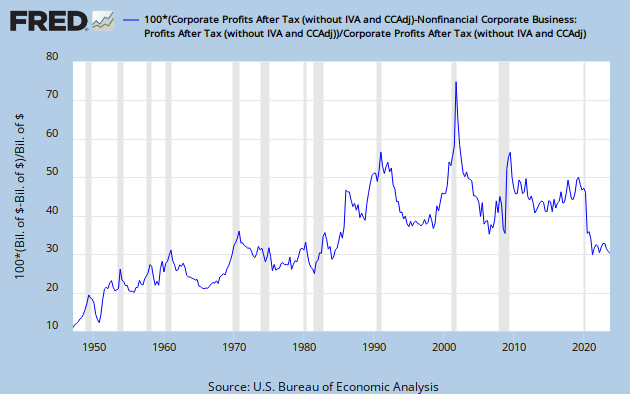
In Part I we saw that labor's earnings have lagged far behind GDP growth.  (More on earnings stagnation here) Meanwhile, corporate profits have grown at a rate that, until recently, increased over time, and they are now at a historically high fraction of GDP.

Here is a specific look at the Finance Sector.  The graph shows finance sector profits as a percentage of total corporate profits - all after tax.  


That's a pretty impressive sweep up over time.  I threw some best fit curves through the whole data set, and also though the peaks and valleys.  Curves through the extremes are exponential.


Along with the increased percentage we get a dramatic increase in the data spread.

When lines jump around a lot, you can sometimes get clarification by looking at a long average.  I tried that here with a 13 year average.


A long average filters out the hash, and reveals the underlying trend.  Or, I should say, trends, since there are two, with a sharp break at the beginning of 1986.  A best-fit least squares trend line on the data through  '85 is a near-perfect match to the average line, which barely even wiggles.  We see a bit more action in the post-85 segment, but the new trend is still very clear, indeed.  The earlier trend line in green is now the lower channel support line. 

The finance sector has captured an increasing fraction of corporate profits, which have been growing at an increasing rate since WWII.  And the growth rates are greatest when the economy is doing the worst.  Take another look at the first graph.  The correlation of finance sector profit peaks with recessions is close to perfect.  Peaks are in Q2-1949, Q3-1952, Q4-1953, Q1-1958, Q1-1961, Q4-1970,  Q1-1986, Q1-1991, Q4-2001.  The peak in 1986 is the only one that does not correspond to a recession.

The finance sector provides a vital function.  It is there to facilitate and enable the wheels of industry to turn.  But policy matters.  What has happened in the age of deregulation and lax taxation is that the finance sector has come to dominate the economy.  This is madness. And here is your Great Stagnation, folks.

Beyond the point of supplying necessary financing for businesses and mortgages, financial manoeuvrings - speculation in particular, and most especially so with sophisticated derivatives that nobody knows how to rationally evaluate - become rent seeking.  This is a massive misallocation of resources, diverting capital from real investment into totally non-value-added financial tail chasing.

And I'm not the only who thinks so.  Here, Paul Krugman calling the whole operation A Giant Scam, quotes Andrew Haldane, Executive Director, Financial Stability, Bank of England:

In fact, high pre-crisis returns to banking had a much more mundane explanation. They reflected simply increased risk-taking across the sector. This was not an outward shift in the portfolio possibility set of finance. Instead, it was a traverse up the high-wire of risk and return. This hire-wire act involved, on the asset side, rapid credit expansion, often through the development of poorly understood financial instruments. On the liability side, this ballooning balance sheet was financed using risky leverage, often at short maturities.
In what sense is increased risk-taking by banks a value-added service for the economy at large? In short, it is not.

Haldane's article was reposted at Naked Capitalism. What he is getting at is the derivatives market, the unregulated darling of the World of High Finance.  Estimates vary, since there is no good way to get a handle on it, but the highly leveraged derivatives market has a notional value somewhere between 10 and 25 times the aggregate value of global GDP.  In the wake of Phil Graham's undoing of Glass-Steagal came a sea change in the way the Finance Sector does business, and along with this came a shift from risk management to risk-making.  As Haldane put it: "If risk-making were a value-adding activity, Russian roulette players would contribute disproportionately to global welfare."

Since none of this activity does anything to create real wealth, it is nothing but rent-seeking.  That is bad, in and of itself.  Worse, still, in Krugman's words: "Wall Street and the City were con artists extracting huge rents from an unwary public (and eventually dumping much of the cost, when things went bad, on taxpayers)."   What is perhaps worst of all is that the money locked up in these ventures is diverted from real investment.

So, here is the picture.  While the average earnings of working stiffs has been stagnant, at best, corporate profits have grown at an increasing rate.  Further, the percentage of those profits going to the Finance sector has also grown at an increasing rate.  Total profit growth is above exponential, and Finance Sector profit growth is super-exponential.

To summarize:
1) Over the last 30 years banking has devolved from a necessary financial function involved in the allocation of resources and management of risk to essentially non-value-added rent-seeking activities implemented through high risk practices.
2) When the whole house of cards came tumbling down, the losses were socialized, while the criminals who perpetrated the underlying fraud walked off not only scot-free, but with huge bonuses.

There might be some way to justify this if it were leading to greater GDP growth or a rising tide that lifted all the boats.  But the opposite has happened.  GDP growth has been in decline for decades, and the tsunami of profits floating the yachts in the Finance Sector has swamped all the dinghies.

Cross Posted at Angry Bear.

Monday, January 23, 2012

Florida

Here is a Romney attack ad on Newt.

Sadly, one of these rats will be the Rethug nominee for president later this year.


Sunday, January 22, 2012

NFL Postseason

The championship games have resulted in the worst possible outcome.

Of course, so did last week's playoff games.

I don't have much feeling one way or the other for the Giants.  I do have some faint positives for the 49ers.  Don't ask me why.  But I loath the Patriots, and I especially loath Tom Brady.  It is particularly disappointing to see them win when he had a pretty bad day.  I did so much want him to be the goat.

Whether I will even watch the Super Bowl is at this point an open question.

As an aside, it seems that neither Joe Flacco nor Alex Smith is above the mediocre level as a QB, despite Smith's heroics last week.